MacTech NEXUS
One system that runs an entire repair and retail shop.
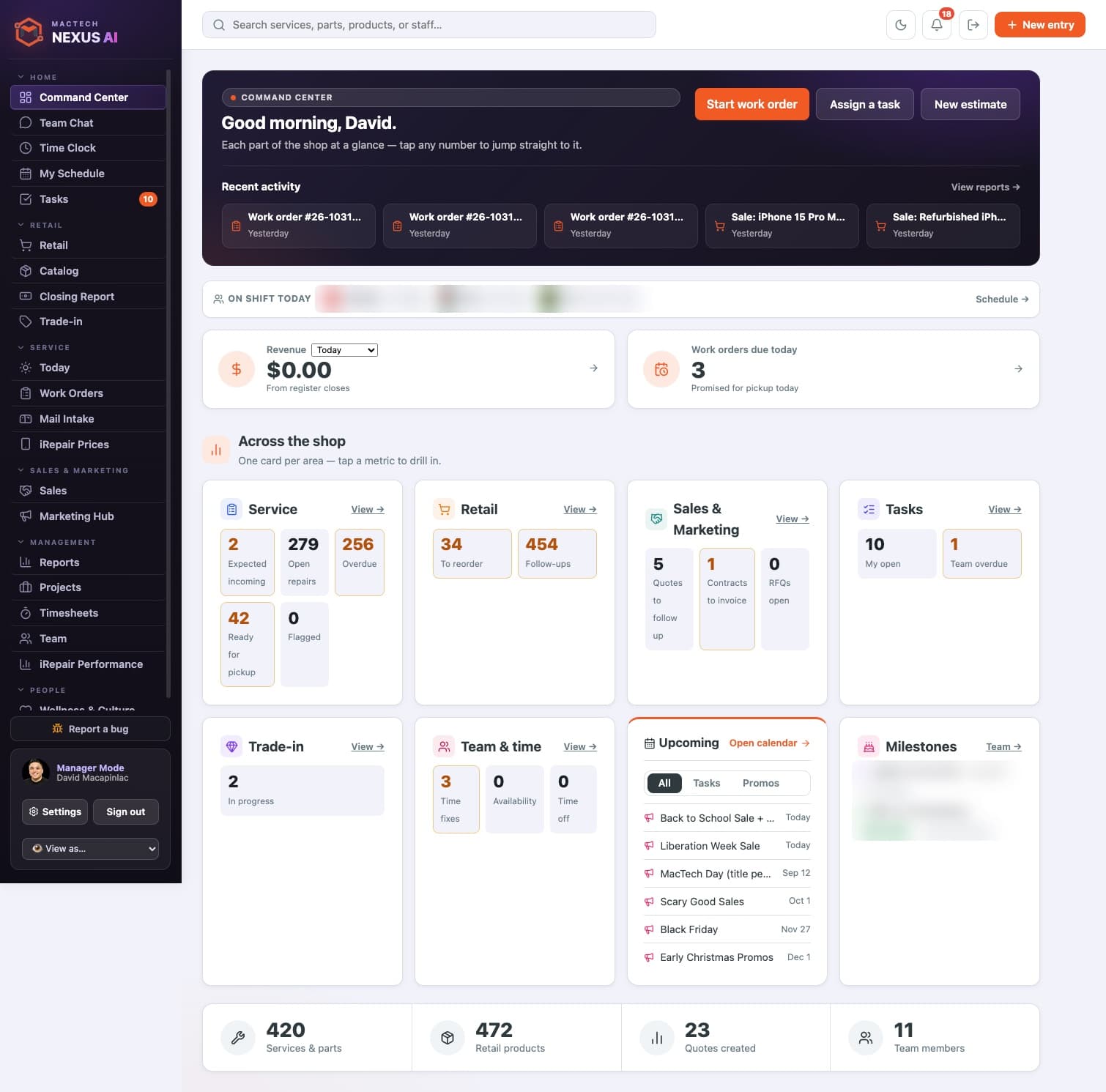
The internal operating system for MacTech Guam's device repair and retail business. Work orders, point of sale, inventory, quotes, payroll, and reporting: one role-aware app that replaced four separate SaaS tools and a wall of spreadsheets.
The problem
Running the shop meant paying for and stitching together MhelpDesk, Homebase, and ShopKeep, none of which matched how the counter, the bench, and the back office actually work together.
The system
A single role-aware platform built around the shop's real workflows. Money is server-authoritative: totals are recomputed in the database, and refunds require a manager code. Staff see only the sections their role permits.
Verified numbers
- 152
- SQL migrations
- 135+
- Page components
schema evolution, hand-applied
Only independently supportable figures appear here.
What happened
- Runs daily operations for a real retail and repair business
- Consolidated four separate tools into one system the team actually uses
Four tools, one counter, no single source of truth
A repair-and-retail shop lives at the intersection of the bench, the counter, and the back office, and those three were running on different software. Repair tickets in one SaaS, scheduling in another, point of sale in a third, and everything they couldn't quite fit into any of them living in spreadsheets.
The cost wasn't just the subscriptions. It was the reconciliation: the same job re-entered three times, totals that disagreed, and a manager who couldn't answer a simple question without opening four tabs.
A system shaped like the shop, not the software
MacTech NEXUS replaced all of it with one role-aware platform built around the shop's real workflow: work orders, customers, retail and POS, inventory, quotes-to-invoices, payment plans, warranties, scheduling, time clock, payroll, and end-of-day cash-up. The counter, the bench, and the office finally read and write the same records.
The discipline that makes it trustworthy is invisible on the surface: money is server-authoritative. Totals are recomputed in the database, refunds require a manager code, and the points ledger can only be written by triggers. Access is enforced by row-level security, not by hiding buttons, so what a role can't do, it structurally can't do.
Proven by the hardest customer: its own operator
MacTech NEXUS isn't a pitch deck. It runs a real Guam business day in and day out, on phones at the counter and PCs in the back, and it has been refined across 152 hand-applied database migrations as the operation's needs changed.
That's the difference between software built for a market and software built by an operator: the shortcomings surface in our own shop first, and get fixed before any client ever meets them.
Inside the system
- Repair work orders with status and close-reason logic
- Customer records
- Retail floor logging, reordering, and POS
- Inventory
- RFQs, estimates, and quote-to-invoice flow
- Payment plans and warranties
- Scheduling and time clock
- Semi-monthly payroll and HR
- Tasks and notifications
- End-of-day cash-up
- Role-based dashboards and reporting
- Thermal receipt printing